Dear OpenFAST developers,
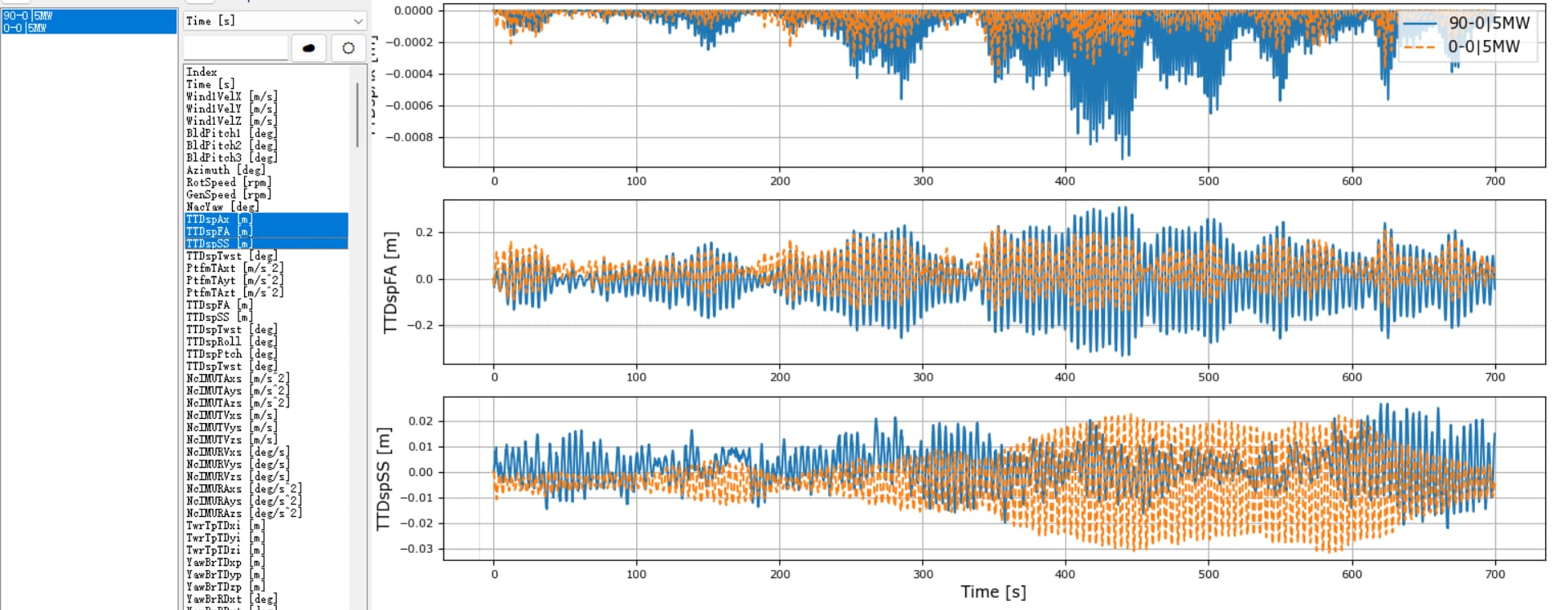
I am performing simulations for the shutdown operating condition. The response induced by blade feathering appears to be larger than that under the non-feathered condition, which seems counterintuitive. What could be the reason for this phenomenon?The following figures show my simulation results and the OpenFAST parameter settings.
Best regards,
dingkan xiao
Dear @Dingkan.Xiao,
Can you clarify your simulation set-up? It appears that you’ve parked the rotor with the blades fixed at 0; is your second simulation (labeled 90-0) with BlPitch(1-3) set to 90?
What are in your InflowWind, AeroDyn, and SoilDyn input files?
Best regards,
Dear @Jason.Jonkman,
Thanks for your message. Yes, I was simulating the situation where the wind turbine stops, so I turned off the generator. My simulation set-up mainly involves two models with different BlPitch parameters. In one model, the pitch angles of all three blades are 0, while in the other model, they are all 90. All other parameters are the same. Below are my InflowWind, AeroDyn, and SoilDyn input files.
Best regards,
Dear @Dingkan.Xiao,
Thanks for clarifying.
Regarding SoilDyn, did you customize SoilDyn in someway? Your input file has features I don’t believe NREL has implemented yet.
Regarding AeroDyn, I see that you’ve enabled BEMT and unsteady airfoil aerodynamics, but these models are only valid for an operational rotor; I suggest rerunning the case with WakeMod = 0 and AFAeroMod = 1. Do the results make more sense to you after that change?
Best regards,
Dear @Jason.Jonkman,
Thank you for your message. As you suggested, I set the parameters in AeroDyn to WakeMod=0 and AFAeroMod=1 and re-ran the simulation. However, the results still show that theNacelle Acceleratio and Platform Acceleration generated by BlPitch(1-3) in the feathered condition (BlPitch=90) is greater than that in the non-feathered condition (BlPitch=0). This appears abnormal. What could be the potential reason for this?This abnormal result has been bothering me for a long time.
Regarding SoilDyn, I had previously customized it in some way. I have now disabled the SoilDyn module while keeping all other parameters unchanged. The simulation fails due to excessively large displacements(The last picture).
Best regards
Dear @Dingkan.Xiao,
Have you looked at deflections in addition to accelerations? Are they what you’d expect? I would expect BlPitch = 0 to result in much more deflection than BlPitch = 90deg when the parked rotor is aligned with the wind. But I would also expect more aerodynamic damping with BlPitch = 0, which would effect the acceleration.
When you disable SoilDyn, you should fully restrain the reaction joint in SubDyn, otherwise, the monopile will not be restrained could fall over.
Best regards,
Dear @Jason.Jonkman,
Thank you very much for your patient response. The results for deflections also appear to differ from expectations. This appears abnormal. As you mentioned, we anticipated outcomes showing more aerodynamic damping with BlPitch = 0. However, the results still indicate that the response generated under the feathered condition (BlPitch = 90°) with BlPitch(1-3) is greater than that under the non-feathered condition (BlPitch = 0°) with BlPitch(1-3). This is truly perplexing. What could be the potential reason for this?
I fully restrain the reaction joint in SubDyn When I disable SoilDyn, However, the results still show that the structural response generated by BlPitch(1-3) in the feathered condition (BlPitch=90) is greater than that in the non-feathered condition (BlPitch=0)(The last 3 pictures)(Under these parameter settings, are the amplitudes of acceleration and displacement too large? The wind speed is 12 m/s.). Would it be possible for me to request your insight into identifying the root cause of this issue?
Best regards,
Dear @Dingkan.Xiao,
Can you share the TurbSim input file you are using to generate 5MW_12ms.bts? Perhaps this wind file has some wind direction inherent in it? To isolate the effect of turbulence, you could compare your results to a simpler case with steady wind (WindType = 1 in the InflowWind input file).
The NREL 5-MW baseline blade is structurally and aerodynamicly pretwisted, so there can be coupling betweeen flapwise and edgewise directions (and likewise for tower fore-aft and side-side directions), but I would still expect 0deg pitch to result in more fore-aft deflection than 90deg pitch if the wind is aligned with the parked rotor. But you could certainly eliminate the structural and aerodynamic twist by setting StrcTwst in the ElastoDyn blade file and BlTwist in the AeroDyn blade files to zero to isolate this effect.
Best regards,
Dear @Jason.Jonkman,
Thank you very much for your patient response. Figure 1 shows the TurbSim input file I am using to generate the 5MW_12ms.bts wind file(WindType=3). I compared the results between WindType=1 and WindType=3, as shown in Figure 2. The two sets of results appear relatively similar, although the response under turbulent wind conditions (WindType=3) seems slightly larger.
When comparing the results for WindType=1 (Figure 3), the response in the fore-aft (FA) direction remains larger for the feathered condition (BlPitch=90) than for the non-feathered condition (BlPitch=0). However, in the side-to-side (SS) direction, the non-feathered condition (BlPitch=0) produces a larger response. Could this be related to the relatively low wind speed of 12 m/s? Is this behavior expected?
As you suggested, I also attempted to set both StrcTwst and BlTwist to zero in both ElastoDyn and AeroDyn. The results are shown in Figure 4. The FA direction response is still larger for the feathered condition (BlPitch=90), while the SS direction response remains larger for the non-feathered condition (BlPitch=0). This is truly perplexing. What could be the potential reason for this?
Is there a method to effectively eliminate or isolate the influence of aerodynamic damping in the analysis?
Best regards,
Figure 1
Figure 2
Figure 3
Figure 4
Dear @Dingkan.Xiao,
It looks like you shared your InflowWind input file instead of your TurbSim input file.
I still see a lot of oscillation in the case with steady wind, which I assume is coming from the wave excitation. I think you need to simplify the model and build-up complexity in steps. I would start with zero blade and aerodynamic twist, steady wind, rigid foundation (no reaction DOFs in SubDyn and SoilDyn disabled) and still water (WaveMod = 0 in HydroDyn); do you get the results you expect then?
Best regards,
Dear @Jason.Jonkman,
Thank you very much for your patient response.yes,what I shared previously was the InflowWind input file. I have now uploaded the TurbSim input file (the .inp file). Could you please review it to see if the issues mentioned above might be originating from the wind field generation settings in this TurbSim input file?
Thank you for your valuable suggestions regarding the configuration with zero blade pitch and aerodynamic twist, steady wind, and a rigid foundation. I will carefully evaluate these ideas and follow up with you for further discussion.
Best regards,
Dear @Dingkan.Xiao,
I don’t have any concerns with your TurbSim inpu tfile. I’ll await news on my other recommendations.
Best regards,
Dear @Jason.Jonkman,
Thank you very much for your patient response. With my simulation parameters set to WakeMod=0, AFAeroMod=1, no reaction DOFs in SubDyn, SoilDyn disabled, WindType=1, StrcTwst=0, BlTwist=0, and WaveMod=0, the obtained results appear somewhat unusual. The values of all output parameters are very small and eventually approach zero. This is likely the system’s response after eliminating wave effects, which indicates that waves have a significant impact on the turbine’s behavior. However, this doesn’t seem directly relevant to the issue I initially intended to investigate (i.e., the response characteristics associated with blade feathering and non-feathering conditions).
My objective is to study the turbine response under a parked and feathered condition. I encountered a puzzling situation where the nacelle acceleration generated in the feathered state (BlPitch=90) is greater than that in the non-feathered state (BlPitch=0). Based on your extensive experience, what do you think could be the potential reason for this phenomenon?Below are my OpenFAST parameter settings.
Best regards,

Dear @Dingkan.Xiao,
What does the tower-top deflection look like for this case? Are you now seeing more deflection at 0deg pitch, as expected?
Best regards,
Dear @Jason.Jonkman,
Thank you very much for your patient response. Regarding the tower-top deflection in the fore-aft (FA) direction, the displacement is indeed larger under the feathered condition. However, this observation deviates from my initial expectations and primary focus. The current setup significantly reduces wave influence by employing still water conditions (WaveMod = 0 in HydroDyn), whereas my actual experiment requires considering wave actions (WaveMod = 2).
Based on your expertise, what would be the potential reason for the FA response under the feathered condition remaining greater than under the non-feathered condition even when wave loads are included (WaveMod = 2)?
Best regards,
Dear @Dingkan.Xiao,
I’m glad you are finally getting results that make sense. Now, I would suggest re-introducing complexity step-by-step to identify which contribution (structural/aerodynamic twist, turbulent wind, flexible foundation, wave excitation) is causing the results you weren’t expecting.
I already see in your results from your simplified model, the tower deflection is quite a bit smaller than what you showed earlier, so, I imagine the wind load may not be playing a dominant role in the tower deflection for your original case.
Best regards,
Dear @Jason.Jonkman,
Thank you for your thorough explanation and patience. As I progressively introduced more complexity into the model, I observed that unexpected results arise specifically when WindType = 3 is used, or when WaveMod = 2 is enabled.
Could the issue lie in the parameter settings of my InflowWind file, or might it be related to the HydroDyn input file?
Attached below are:
-
The results with WindType = 3 only (with WaveMod = 0),
-
The results with WaveMod = 2 only (with WindType = 1),
-
As well as the InflowWind and HydroDyn input files.
Best regards,
Dear @Dingkan.Xiao,
Your results with WindType = 3 (compared to WindType = 1) with WaveMod = 0 makes sense to me. The mean response between two two cases is similar with turbulent case leading to more variation.
When waves are enabled with WaveMod = 2, the waves seem to dominate the response.
Best regards,